
If you employ staff in South Africa, October brings an important SARS compliance deadline.
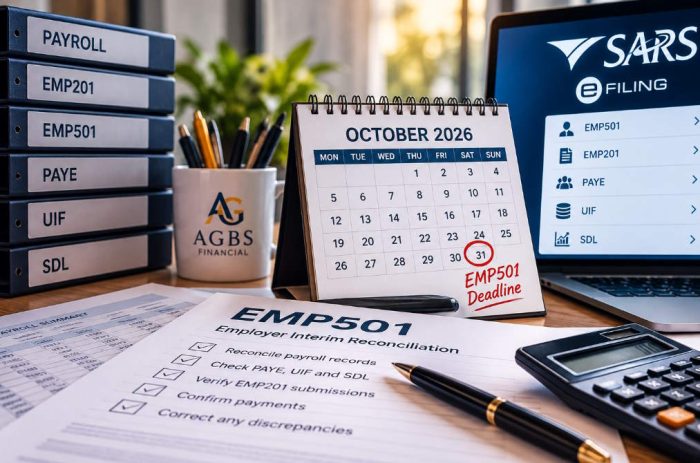
The 2026 Employer Interim Reconciliation submission period runs from 21 September to 31 October 2026. We designate the EMP501 2026 submission as such, but more precisely, we designate it as the 08/2026 submission.
During this period, employers must reconcile their payroll information for the six months from 1 March to 31 August 2026 and submit an EMP501 declaration.
It sounds straightforward.
In practice, the reconciliation can expose problems that have been building quietly throughout the year.
What exactly is being reconciled?
The EMP501 brings several sets of information together.
Employers need to ensure that PAYE, UIF and SDL figures reconcile with the EMP201 declarations previously submitted to SARS.
Actual payments made to SARS must also be considered, together with payroll information and the employee tax certificates generated for the period.
Essentially, SARS expects the different parts of the payroll compliance process to agree.
If they do not, the difference needs to be investigated.
Why employers should not leave this until 31 October
We do not view reconciliation as just another return due on deadline day.
Differences can arise from relatively simple issues:
We may have calculated PAYE incorrectly.
We may have loaded the employee incorrectly.
The finance team may have allocated the payment incorrectly.
An EMP201 may contain an error.
Payroll records may not agree with amounts previously declared.
Employee tax numbers or personal details may be incomplete.
You may need to make corrections before you can submit a clean reconciliation.
Finding these problems on 30 October leaves very little time to investigate them.
PAYE differences can become expensive
SARS has warned employers that incorrect calculation of monthly PAYE can result in penalties and interest.
Importantly, corrections made during the EMP501 reconciliation can cause the last month of the reconciliation period to bear any shortfall.
The purpose of the reconciliation should therefore not simply be to make the software accept the submission.
The underlying figures need to make sense.
Late EMP501 submissions can result in penalties
SARS states that late submission can attract an administrative penalty equal to 1% of the employer’s annual PAYE liability, increasing by a further 1% for every month that the return remains outstanding, up to 10%.
For employers participating in the Employment Tax Incentive, non-compliance may also affect unused ETI.
That makes the EMP501 more than an administrative inconvenience.
Employee information matters too
Payroll compliance affects employees as well as employers.
Employer information submitted to SARS feeds into employee tax certificates, individual income-tax returns and SARS Auto Assessments.
SARS itself identifies employer data as an important input into employee assessments, Auto Assessments and pre-populated ITR12 returns.
An error in payroll can therefore travel much further than the employer’s own SARS account.
Five things we recommend checking
Before submitting the interim reconciliation, employers should consider whether:
- EMP201 declarations agree with payroll records.
- We have correctly paid and allocated PAYE, UIF and SDL payments.
- Employee personal and tax information is complete.
- IRP5/IT3(a) information agrees with the underlying payroll.
- We have investigated any differences rather than simply overriding them.
Employers should also retain payroll records. SARS guidance requires employers to maintain relevant records for five years.
Payroll is more than calculating salaries
Businesses calculate payroll monthly to determine employees’ pay.
In reality, payroll connects employment contracts, remuneration, PAYE, UIF, SDL, employee tax certificates and SARS reporting.
A payroll system can calculate numbers, but those numbers still need to be correctly configured and reconciled.
AGBS Financial can assist
AGBS Financial assists businesses with payroll administration and SARS employer compliance, including EMP201 and EMP501 submissions.
Our approach is not simply to submit the return and move on.
Where possible, we want the payroll records, declarations and payments to agree so that problems can be addressed before they affect the employer or employee.
If you have not yet started your October 2026 EMP501 reconciliation, now is the time to do so. The deadline is 31 October 2026.